
Bee Storage Guides
Running Out of Room? What Size Storage Unit Do You Actually Need?
Not sure what size storage unit you need? Our simple storage size guide explains what typically fits and how to choose the right space.
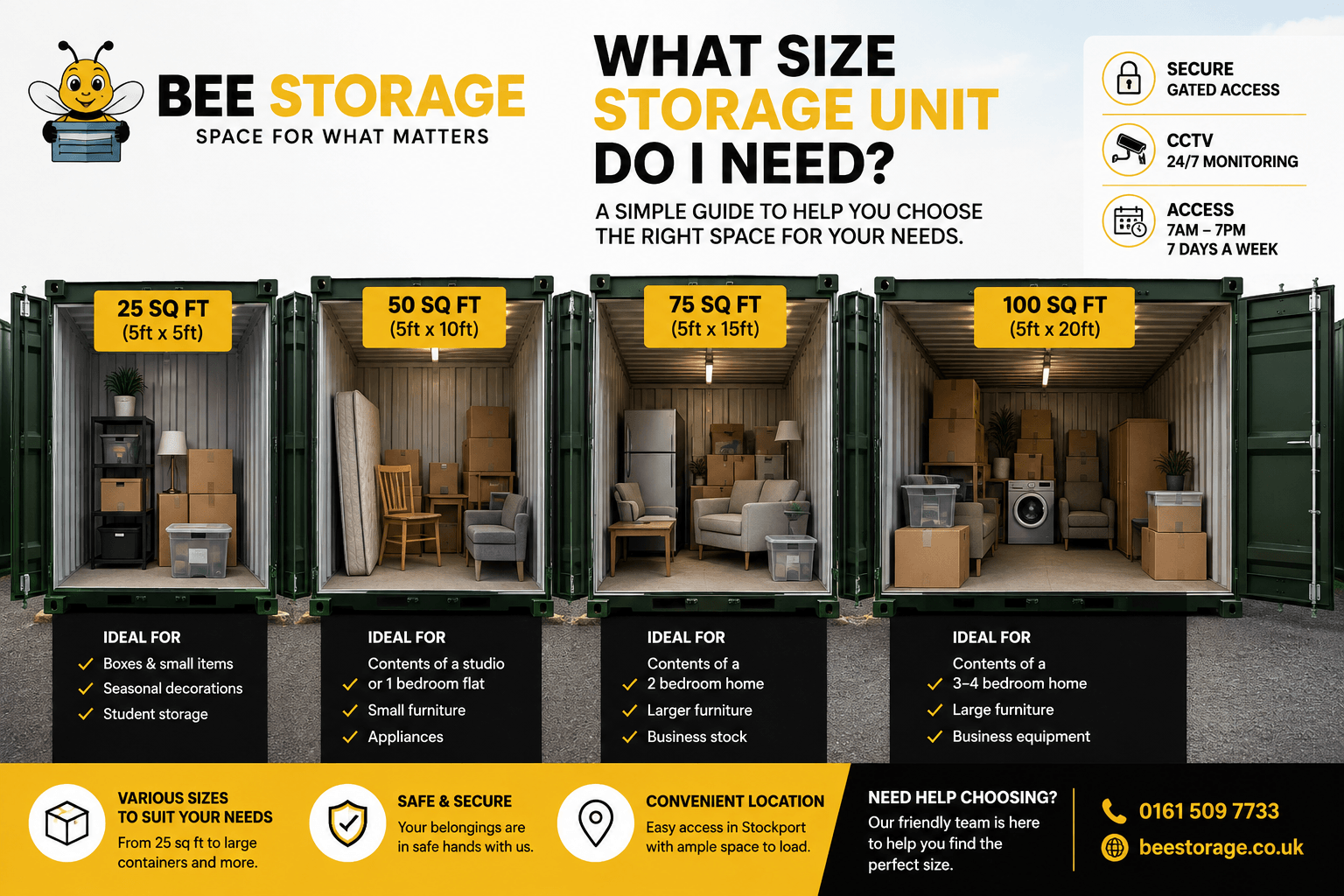
Wondering what size storage unit do I need? A few simple checks can help you choose the right amount of space without paying for more than you need.
Go too small and you could end up trying to squeeze everything into a unit that simply doesn’t work. Go too big and you’re potentially paying for empty space you don’t need.
The good news is you don’t need to measure every box in the house. A rough idea of what you’re storing — and how you’re going to use the space — can usually get you pretty close.
What Size Storage Unit Do I Need?
The right storage unit size depends on what you’re storing, how much furniture you have, how efficiently everything can be packed and whether you’ll need regular access to your belongings once they’re inside.
As a rough guide, independent UK consumer advice suggests:
Around 40–75 sq ft
Could be suitable for the contents of a typical one-bedroom flat, depending on how much furniture and how many boxes you have.[1][2]
Around 75–100 sq ft
Could provide enough space for the average contents of a two-bedroom house or flat.[2]
Around 120–150 sq ft
Could be suitable for the contents of a typical three to four-bedroom home.[2]
These are only estimates — and that’s important.
Which? points out that storage unit descriptions aren’t standardised across different storage companies. The same 50 sq ft space, for example, may be described differently depending on the provider.[1]
That’s why we’d rather help you think about what you’re actually storing, rather than simply telling you that a certain number of bedrooms automatically means a certain size unit.
Think about what you’re storing, not just your house size
Two people living in almost identical houses could need completely different amounts of storage.
One might be storing beds, wardrobes, sofas, white goods, garden furniture and dozens of boxes.
The other might only need somewhere for boxes, clothes and a few pieces of furniture while decorating.
The address might be similar. The amount of storage needed isn’t.
Start with your biggest items first.
Think about sofas, beds, mattresses, wardrobes, tables, appliances and other bulky items. Then consider how many boxes and smaller belongings need to fit around them.
It gives you a much more realistic idea of the space you’re going to need.
Don’t forget — storage goes upwards too
A storage unit isn’t just its floor space.
Making sensible use of the height can significantly change how much you can fit inside. Boxes that can be safely stacked and furniture positioned efficiently can help you make much better use of the available space.
But don’t get too carried away trying to use every last inch.
Which? recommends leaving space such as a pathway through your belongings if you’ll need to access them, rather than packing everything so tightly that you have to empty half the unit to reach one box at the back.[1]
So there’s another question to ask yourself:
“Am I putting everything away and leaving it there, or will I regularly need to get things out?”
If you’re storing the contents of your house for a move, you may be happy packing everything efficiently from back to front.
If you’re storing business stock, tools or belongings you’ll regularly need, having a little room to move around can be much more useful.
What if I need much more storage space?
Sometimes you simply have more to store.
If you’re moving a larger amount of furniture, storing bulky items or need space for substantial amounts of business stock, tools or equipment, a larger storage option may be more appropriate.
Bee Storage also offers 10ft and 20ft storage containers, which can be particularly useful when you need more space or have larger items to store.
Explore 10ft & 20ft Storage Containers →
The right size isn’t always the biggest size
It’s easy to think having extra room is better, but you’re ultimately paying for the space you rent.
HomeOwners Alliance specifically recommends working out how much space you actually require so you don’t end up paying for more self storage than you need.[2]
So before choosing your unit, make a quick list.
What are the biggest things going in?
How many boxes do you roughly have?
Can items be safely stacked?
And will you need to regularly get to anything once it’s stored?
Answer those questions and choosing the right storage unit becomes much easier.
Still not sure what size you need?
Don’t worry about calculating everything down to the exact square foot.
Bee Storage offers a range of self storage options in Stockport for moving house, decluttering, students and businesses.
Tell us roughly what you’re planning to store and we can help you work out which option makes the most sense — without paying for lots of space you don’t need.
View our Storage Options, take a look through our Storage FAQs, or contact the bee storage team for help choosing the right size.
Sources & further reading
[1] Which? — Self-storage: how much it costs, and how to save money
Independent UK consumer guidance covering typical storage requirements, unit sizes, access and the differences between providers’ size estimates.
[2] HomeOwners Alliance — Self Storage: What to Consider
Independent homeowner guidance on estimating storage space, including approximate requirements for one-bedroom flats through to larger family homes.