
Bee Storage Guides
How to Protect Your Belongings & Business Items in Self Storage
Simple ways to protect household belongings, business stock, tools and equipment while they’re in self storage.
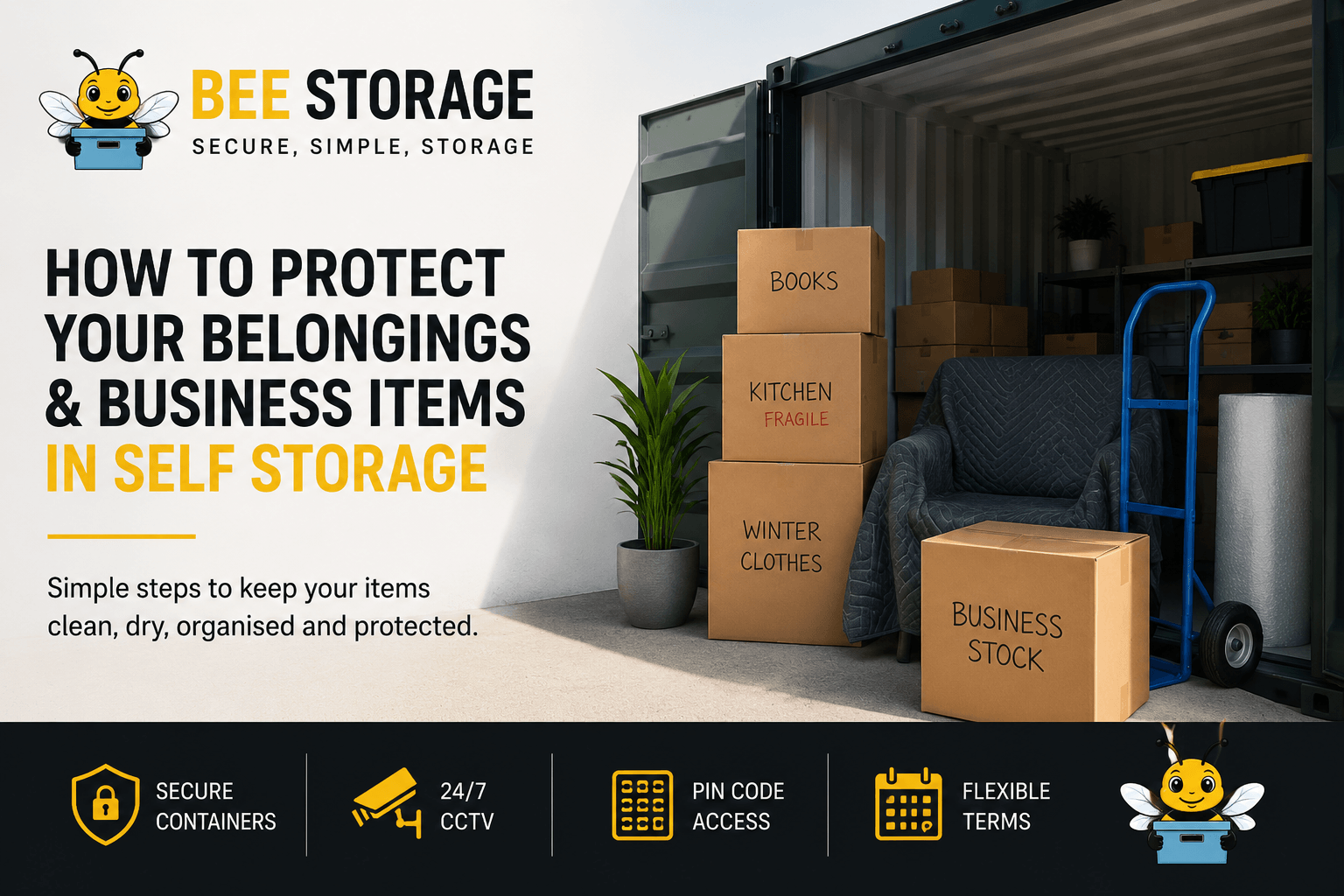
If you’re wondering how to protect items in self storage, a little preparation before everything goes into your unit or container can make a big difference.
Different items need different treatment. A box of paperwork shouldn’t necessarily be packed in the same way as tools, clothing, electronics or household belongings.
But one rule applies to almost everything: put it into storage clean, dry and properly packed.
Taking a little time to prepare your items can help protect them from knocks, scratches, moisture and unnecessary damage while they’re stored.
How Do I Protect Items in Self Storage?
The best way to protect items in self storage starts before you load the unit or container.
Check what you’re storing, clean and dry anything that needs it, use suitable boxes or protective materials and think about how everything will be arranged once it’s inside.
For personal storage, that might mean protecting clothes, books, appliances, photographs and household belongings.
For a business, it could mean keeping stock boxed and labelled, putting tools away clean and dry, protecting equipment from knocks and keeping important paperwork organised.
The aim isn’t to wrap absolutely everything in layers of packaging. It’s to give each type of item the protection it actually needs.
Start with clean and completely dry items
Anything going into storage should be clean and completely dry first.
That applies whether you’re storing a sofa from home, boxes of clothes, metal tools or stock from your business.
Dirt and moisture are much easier to deal with before an item goes into storage. Damp conditions can contribute to mould and deterioration in materials such as textiles, paper, leather, wood and metals, so don’t pack something away while it’s still wet from cleaning or has been left outside in the rain.
For tools and equipment, remove dirt and make sure they’re dry before putting them away. For clothes and bedding, wash and thoroughly dry them before packing. Furniture should also be clean and dry before it’s covered.
And if you’re storing a fridge or freezer, empty, defrost, clean and dry it properly first. Manufacturer guidance also recommends leaving the door slightly open while an appliance is switched off for a long period to allow airflow and help prevent mould
Use the right packing materials for what you’re storing
There isn’t one type of packaging that’s right for everything.
Strong boxes are useful for smaller household belongings, paperwork and business stock. Label them clearly so you know what’s inside without having to open every box later.
Fragile items may need additional padding, while furniture can be protected from knocks, dust and scratches with suitable furniture covers or moving blankets.
Avoid simply wrapping every item as tightly as possible. Upholstered furniture, textiles and other moisture-sensitive belongings shouldn’t be packed away damp or wrapped in a way that traps residual moisture.
For more detailed advice specifically about sofas, tables, beds and other household furniture, see our How to Protect Furniture in Storage guide.
Pack boxes so they protect what’s inside
Strong boxes make it easier to protect smaller belongings, paperwork and business stock, but how you pack them matters just as much as the box itself.
Avoid making boxes so heavy that they’re difficult to lift safely. Put heavier, sturdier items towards the bottom and lighter or more fragile belongings above them.
Fill empty spaces around fragile items with suitable packing material so they can’t move around easily when boxes are carried or stacked.
For business stock, keeping similar products together can make the storage space much easier to manage. Clearly mark the contents, quantities or product type on the outside so you don’t have to open several boxes every time you need something.
For personal storage, simple labels such as Kitchen, Books, Winter Clothes or Bedroom can save a lot of searching later.
And whatever you’re storing, don’t balance heavy boxes on top of furniture, fragile items or anything that could be crushed.
Take extra care with paperwork, photographs and important documents
Paper and photographs need a little more thought because moisture can cause lasting damage.
The National Archives recommends keeping archive material boxed and highlights damp as a condition that can encourage mould growth.[1]
Before storing paperwork, make sure everything is completely dry. Use suitable boxes or document containers and avoid leaving important papers loose where they can be bent, crushed or damaged by other items.
For a household, that might include photographs, certificates and sentimental documents.
For a business, it could include archived records, invoices, manuals or other paperwork that needs to be kept organised.
If something is particularly valuable, irreplaceable or needs tightly controlled environmental conditions, check whether standard self storage is appropriate for that item before putting it away.
Think about access before you start stacking
It’s tempting to fill every available gap, but think about what you’ll need to get to later before you start stacking boxes.
Put heavier, sturdier boxes towards the bottom and avoid placing heavy items on anything that could be crushed or damaged.
Leave yourself a sensible route through the storage space if you’ll need regular access. There’s little benefit in fitting in one extra box if you have to unload half the unit every time you need something from the back.
For personal storage, keep things you may need sooner — seasonal clothes, documents or frequently used household items — somewhere accessible.
For a business, think about stock rotation and how often you use particular tools or equipment. Frequently collected stock or everyday equipment is usually more useful near the front than underneath six other boxes.
If you’re still deciding how much room you’ll need, our What Size Storage Unit Do I Need? guide explains how access and layout can affect the amount of storage space that makes sense.
Store tools and work equipment clean and organised
Tools and work equipment deserve the same preparation as household belongings.
Remove dirt and make sure tools are dry before putting them into storage, particularly metal equipment that could be affected by moisture.
Keep smaller tools together in suitable toolboxes or containers, and organise larger equipment so it can be removed without having to shift everything else first.
For tradespeople, separate storage can also mean you don’t have to carry every tool and piece of equipment around in the van every day.
Protect business stock as carefully as personal belongings
Business stock can represent a significant investment, so don’t treat your storage unit as somewhere to simply pile boxes until they’re needed.
Keep products in suitable packaging, label boxes clearly and organise stock so you can reach what you need without repeatedly moving everything around.
Avoid putting heavy boxes on products that could be crushed, and keep fragile or higher-value items somewhere they’re less likely to be knocked while other stock is being moved.
If you’re regularly adding and removing products, having a simple system can help too. Keep similar stock together and consider arranging older stock so it’s easier to access before newer deliveries.
For businesses that are starting to run out of room at home, in the garage or at their existing premises, our Can I Use Self Storage for My Business? guide looks at when business self storage could make sense
Take care with electronics and appliances
Electronics and appliances should go into storage clean, dry and properly prepared.
Where possible, keep smaller electronics in suitable protective packaging and avoid placing heavy boxes or equipment on top of them.
For larger appliances such as fridges and freezers, remove all food, defrost them completely, clean them and allow them to dry thoroughly before storage.
Cables, remotes and smaller accessories can easily go missing, so label them or keep them together with the item they belong to.
And before storing anything containing batteries, fuel, oils or other potentially hazardous materials, check the storage rules first. Some items may need batteries or fuels removed, while others may not be suitable for self storage at all.
Check what you can — and can’t — put into storage
Part of protecting your belongings is making sure everything you’re storing is actually suitable for self storage.
Items such as flammable or hazardous materials, explosives, illegal goods, perishable food and anything that could leak, attract pests or cause damage shouldn’t be placed into a storage unit.
Businesses should take particular care with trade materials, chemicals, fuels and equipment containing potentially hazardous substances.
If you’re unsure about a particular item, check with the Bee Storage team before bringing it to the site. It’s always better to ask first than discover something can’t be stored after you’ve arrived.
A little preparation goes a long way
Whether you’re storing household belongings or business stock and equipment, protecting what’s going into storage starts with good preparation.
Clean and dry items first, use suitable packaging, label boxes clearly, stack carefully and think about what you’ll need to access later.
And if you’re unsure whether a particular item is suitable for storage, check before bringing it to the site.
Bee Storage provides personal, home and business self storage in Stockport, with indoor storage units and outdoor drive-up containers for a wide range of storage needs.
View our Personal & Home Storage, explore Business Storage, read our Storage FAQs, or contact the Bee Storage team if you’re unsure about what you’re planning to store.